
Unishippers Logistics Executive Spotlight: Dustin Wesley, EVP of Partner Channel
For more than 20 years, Dustin Wesley has built his career in logistics by doing what he enjoys most: helping people and businesses grow.
Today, Wesley brings that experience to his role as Executive Vice President of Partner Channel, overseeing the Unishippers Franchise Program and GlobalTranz Freight Agent Program within ShipStation Global’s family of brands. He works closely with the entrepreneurs who embody the same kind of culture that first drew him to the business as a logistics account executive with Worldwide Express in 2005.
More than two decades later, what drives him hasn’t changed. Wesley is energized by the people and culture surrounding the business, the relationships he’s built with franchise owners and the opportunity to help entrepreneurs build something of their own. He’s also excited about the newly formed ShipStation Global and what its combination of people, technology and logistics expertise can mean for the future.
We recently spoke with Wesley about his career in logistics, what makes the Unishippers franchise opportunity different, what successful franchise owners have in common and why he believes the best is still ahead.
You’ve spent more than 20 years in logistics, which is practically your entire career. What initially drew you into the industry, and what has kept you here all these years?
I originally joined Worldwide Express because I was looking for a sales job. I had interviewed with a handful of different organizations selling different types of products and services. But I think what ultimately landed me here is also what kept me here: the people and the culture.
I started working for one of our franchisees, and it was a very entrepreneurial, smaller-company environment. You could come in, do good things and have an impact almost immediately. That’s what initially drew me here.
And that’s still what makes our organization and the Unishippers Franchise Program incredibly unique. I love our corporate team. The people supporting our franchisees are amazing, they’re passionate and they’re great at what they do. But it’s also the franchisees and the people they recruit, hire and develop who drive so much of that culture.
You’ve had a front-row seat to the Unishippers Franchise Program since its inception. How has it evolved?
You could argue that the business model hasn’t changed much in 20 or 30 years. But in some ways — and for the better — I think it’s evolved tremendously.
Decades ago, we sold territories where franchisees had exclusive geographic areas in which they could work with customers. That’s fundamentally changed. Today, we have a national franchise model. You could have 10 franchisees in the same town, but they can call on customers and opportunities all over the country. That has provided franchisees with broader flexibility to pursue customers and growth opportunities without the prior constraints.
The other fundamental change is how our franchise agreements are structured. After a certain period of time, we have the option to buy the business at a set multiple, and we’ve exercised that option throughout the system. There aren’t many businesses where you can build that kind of value, potentially monetize that value if the company elects to exercise its purchase option, and then have the opportunity to start the process again.
The way I explain it is that our franchisees know how long of a race they’re probably running, so they know how fast they need to run. They also know what they’re chasing and have visibility into the buyback formula if the company elects to exercise its purchase option.
That buyback possibility has come up in several of our conversations with franchise owners. What’s especially interesting is that a company buyback doesn’t necessarily mean they’re finished with Unishippers, does it?
What’s really unique is that nearly all the franchisees whose businesses we’ve acquired — assuming they weren’t ready to retire — have come back and signed up with us again. They want to start over and have that same experience again, but this time build an even bigger business.
It allowed them to monetize the work they’ve put into building that business, but it also gave them capital to immediately reinvest. We’ve been calling those their “2.0 franchises,” and we’ve seen people ramp those businesses much faster than they did their initial franchise.
Many times, it expands from there because these owners have hired, trained and developed people they now want to partner with and pay it forward to. Some franchisees have gone on to start one, two or three additional franchises, and the national structure gives us the flexibility to support that.
We call it the franchise flywheel: build, sell, rebuild, sell. It all builds on itself.
One thing we’ve heard repeatedly from franchise owners is that there’s plenty of friendly competition, but there’s also this belief that “a rising tide lifts all boats.” Those ideas almost sound contradictory. How do they work together in the Unishippers culture?
Our franchisees are very competitive. They’re entrepreneurs. They want to build businesses, foster customer relationships and grow. We foster a lot of that competition and accountability in our company culture. We distribute weekly stack rankings around production, from franchisees down to sales managers and salespeople. Performance and numbers matter.
But at the same time, they’re all rooting for each other. They want to do well, and they want their neighbor to do well. Now, don’t get me wrong, they want to do a little bit better than their neighbor. They want to be ahead of them on the report or in the contest. That competitive nature is absolutely part of the culture.
What makes it work is that there’s also a tremendous amount of sharing. Our team is constantly looking at what our top-performing franchisees are doing. What’s working? What are they doing differently? What have they figured out that we weren’t doing a year ago or even two months ago? Then we can share that across the franchise network.
That’s the beauty of having entrepreneurial-minded partners. They’re willing to try things and think about the business differently. Something that’s working for somebody in California may also work for somebody in Florida.
We’re very intentional about creating those relationships. We have sales conferences, regional meetings and franchise-led peer groups where owners can get together and talk about what’s working. We want our franchisees to collaborate. There are other franchise organizations that try to keep everybody at arm’s length. We take a very different approach.
You mentioned “entrepreneurial-minded partners,” and that brings up an important distinction. Someone can be a great entrepreneur and still not necessarily be the right fit for this particular franchise. Who is the Unishippers opportunity really built for?
Here’s how I sum it up when we’re talking to prospective franchisees: For the right entrepreneur, I think this is an absolutely amazing opportunity — not just in logistics, but in franchising. But for someone who isn’t a good fit for the model, they’re going to be miserable here.
When people hear “franchise,” they may picture a traditional retail franchise. You invest in a location, put the sign out front, open the doors and wait for customers to walk in. That is not this opportunity.
This is much more focused on sales and new business acquisition. You have to be out there playing offense. You have to take the initiative to prospect and find small and midsized businesses, get meetings with the right decision-makers and then have that sales bone in your body to move those prospects through the sales process and ultimately convert them into customers.
What’s great is that we have the playbook. We train people on how to get leads, set meetings, run sales meetings, transition customers and follow best practices for retaining and supporting them. But you still have to have the desire, willingness and ability to go do those things.
For somebody who has that sales bone, is entrepreneurial-minded, is motivated and is willing to put in the work to build a customer base, it can be an incredible recurring-revenue oriented business model. We’re looking for companies shipping packages or pallets every day that need our help. And we’ve tried to structure the model so franchise owners can focus their time on new sales and retaining those customers.
At the same time, a Unishippers franchise owner isn’t building completely on their own. Today, they have the scale of ShipStation Global behind them. What does that larger organization make possible for an individual franchise owner?
There absolutely is an advantage. In our industry, like many others, size, scale and relevancy matter to our carrier partners. Our UPS® partnership is a huge part of the franchise opportunity and one of the things that makes it unique relative to other entrepreneurial opportunities in logistics.
Our franchisees also get to take advantage of the entire size and scale of ShipStation Global: the carrier relationships, incentives and pricing, technology, competencies, software and capabilities across the brands.
I think it’s incredibly unique that somebody who is entrepreneurial-minded can join us and get access to the same types of resources our existing direct salespeople have when they go out and work with customers — even if that franchise owner is brand-new to the organization.
There’s a ton of power in that. We’ve got the playbook, the addressable market is incredibly large, and franchisees have access to our carrier partners, technology, support and everything we’ve learned along the way. I just think it’s pretty darn unique.
Training is another thing franchise owners bring up again and again when we talk to them. You actually went through that training yourself earlier in your career. What makes the Unishippers approach different?
I think what makes it different is that it’s very real. We try to make our sales training as real-world as possible and prepare people for what they’re actually going to face, experience and see.
It’s not just product knowledge. We have that, too. You can watch a video or read material to learn about products and services. But the secret sauce is the practical, real-world part of the training and the competitive nature of our culture that carries into it.
You’re sitting in a room with your peers, and you’re going to get put on the spot. You’re going to role-play situations. Here’s the business. Here’s what they do. How would you handle it if the business owner said this? How would you respond to this objection? And you may be doing that in front of 20 or 30 people.
If you’re wired the right way, you want to do well in those environments. We intentionally push people because we’re trying to prepare them for what’s coming.
We’re also direct with our feedback. In the real world, somebody may hang up on you. They may not call you back or respond to your email, and they’re probably not going to tell you why. Our job in training is to give you that feedback — to tell you why you might not get that call back and help you get better. The intent is genuinely to help people succeed.
You’ve helped and supported franchise owners for years. When you look across your career, what has been the most rewarding part of it for you personally?
I think I’m incredibly lucky because a lot of our franchisees are people who have been in and around the business for decades, not just a few years. There are genuine, lifelong friendships that have formed through all of this, and I’ve learned as much from a lot of our franchisees as I hope they’ve learned from us.
When you have those relationships and friendships, and everyone is pulling on the same end of the rope, that can create real power and growth. When I visit a franchisee or we have training in town and go to dinner, a lot of those moments feel like I’m doing this with people I’ve known for 10, 15 or 20 years.
Even with newer franchisees, it becomes personal because we care so much about watching people start from scratch and work their way up. That becomes an emotional and rewarding thing for all of us.
The other really cool part has been seeing the next generation of franchisees come in. Some were Worldwide Express franchisees years ago. Some worked for franchisees, left the company and eventually came back. Now they’re getting the opportunity to start something and build something for themselves. And in some cases, we’ve already seen that come full circle, with them building their businesses and eventually selling them back to us.
To get to watch that happen with people you genuinely enjoy being around is really unique. We’re lucky.
That brings us to the future. Nobody invests in a franchise — or any business — without thinking about what comes next. With the newly formed ShipStation Global and the logistics industry in general, what gives you the most confidence about the future of the Unishippers Franchise Program?
I think history is a good guide. Look at how much the business has evolved and what we’ve built over time. We developed an incredibly unique relationship with UPS. We’ve built significant capabilities in LTL and full truckload. When you look across those areas, we have the three main U.S. domestic shipping modes targeted.
Then you fast-forward to today and the formation of ShipStation Global. Having been here through other transformational moments, this one feels different to me because of how complementary the organizations are.
The legacy WWEX Group organization had an incredible commercial engine driven by Unishippers franchisees, GlobalTranz freight agents and the Worldwide Express direct sales team. Then you look at what legacy Auctane brought in technology and marketing. When you bring those competencies together and leverage the best of all worlds, I think it creates an incredible runway and an incredible future for us. I can confidently say I’ve never been more excited about the next five years than I am right now. Our partnerships continue to evolve, and we have more momentum on the franchise side than we’ve ever had. The first eight months of 2026 were the best first eight months of any year in Unishippers history.
Things continue to compound and build. Momentum and trajectory are very real things in our business, and the arrow is pointing up and to the right. We are focused on keeping it that way.
We’ve talked about the opportunity, training, culture and where the program is headed. Let’s bring it back to the individual owner. When you look at the people who have really excelled, what separates a successful Unishippers franchise owner?
First, you have to be willing to put in the work. It’s a cold start. When you’re starting fresh, you don’t have customers or leads. It takes hard work and dedication to get the business off the ground.
But when I look at our most successful franchisees, there are some common themes. One of the biggest is that they’re laser-focused on spending time with shippers and companies that are a good fit for our offering.
There are millions of businesses in the U.S., and at some point almost every business has to ship something. But that doesn’t mean every business is the right opportunity for us. Our most successful performers are active. They talk to a lot of businesses, and when they find one that isn’t a good fit, they’re willing to move on immediately. They know that if they keep going, eventually they’ll get in front of the businesses that really need our help and are a great fit for what we do.
Where people can get caught up is when they aren’t active enough or aren’t prospecting enough businesses. They don’t have enough in the sales funnel, and inevitably they start trying to put square pegs in round holes.
The short way to describe it is that our most successful performers follow the playbook. They follow what’s working, and they don’t stray from it. This is a pretty simple business in a lot of ways. Sometimes people want it to be more complicated or sexier than it is. It’s not.
If you’re willing to embrace that, there’s a lot of fun to be had along the way.
And despite all the technology available today, there’s one piece of advice we hear from franchise owners over and over: You can’t be afraid to pick up the phone. Is that still as important as ever?
Absolutely. It goes back to prospecting. You have to call on businesses and find out: Do they ship? How much do they ship? What are they shipping? Who are they shipping with? For a lot of our people, the way they find that out is by picking up the phone and making the dials.
A few decades ago, when franchisees had exclusive territories, people did more of that prospecting in person. That’s how I learned. We had to go out, turn over every stone and look around every corner to find these businesses.
The method may have changed, but the principle hasn’t. If people aren’t willing to make the dials, find the leads and do those things, they’re not going to think this business is very fun.
And I think that applies to any acquisition sales position. You have to be out there playing offense. You have to find businesses that are a good fit for what you’re selling and who you represent. So, when franchise owners say you have to pick up the phone, they’re absolutely spot on.
Interested in a rewarding franchise opportunity? Reach out to Unishippers today!
Whether you're exploring franchises or looking for family business opportunities, Unishippers is here to help. We provide the tools, support and roadmap to help qualified entrepreneurs build and grow their businesses.
Let's talk about whether the Unishippers franchise opportunity may be a fit for you. Contact us today to learn more!
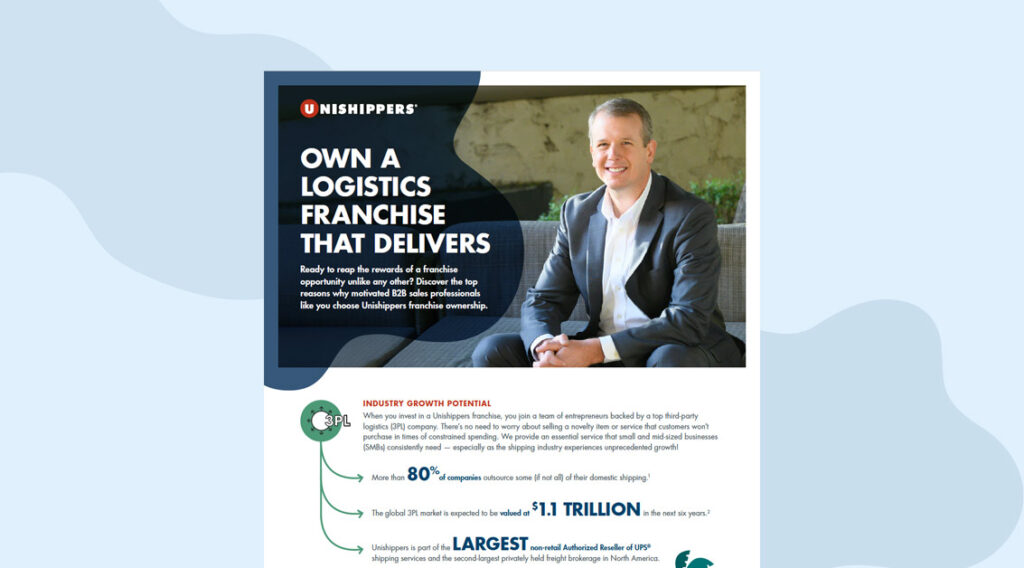
Fast Facts: Benefits of a Unishippers Franchise
Our franchise owners benefit from top training, support & logistics solutions. Download our one sheet to learn more!